Pakistan once again has chosen a risky course to serve interests of the sole superpower. Seemingly, this course has been chosen to secure the system put in place post-2024 elections. Having played a risky hand one can only pray Allah saves Pakistan from pitfalls of this course and help those in helm of affairs to navigate safely
Pakistan in the VUCA World
Zeitgeist is a German word which means, “spirit of the time, or spirit of the age”. It refers to the general intellectual, moral, cultural, and political climate or “vibe” that defines a specific period in history. Let us see what have been zeitgeist of various eras:
1. Ancient Classical Era (800 BCE–500 CE)
Wisdom, order and civic virtue ie a good society is built on wisdom, virtue and order.
2. Medieval Era (500–1500) Faith, tradition and divine order ie life and society should conform to a higher divine order.
3. Renaissance (14th–16th centuries) Human potential and rediscovery ie human beings can understand, create and transform their world.
4. Enlightenment (17th–18th centuries) Reason, liberty and progress ie human reason can improve society and political institutions.
5. Industrial and Nationalist Era (18th–19th centuries) Progress, production and national identity ie nations and societies can advance through industry, innovation and collective identity.
6. Early 20th Century (1900–1945) Mass mobilisation, ideological struggle and crisis ie the future depends on the struggle between competing political and social systems.
7. Post-war and 1960s Era (1945–1970s) Reconstruction, emancipation and mass prosperity ie society can be rebuilt to deliver greater equality, freedom and security.
8. Late 20th Century (1980s–1990s) Markets, individualism and globalisation ie open markets, individual initiative and international integration can generate prosperity.
9. Early Digital Age (2000–2015) Connectivity and possibility ie information and connectivity can make the world more accessible and interconnected.
10. Contemporary Digital Era (2015–todate) Contestation, identity and uncertainty ie the struggle is increasingly over information, identity, trust and who gets to define reality.
An analysis of the evolution of zeitgeist highlights that humankind has transitioned from morals, civic virtue, wisdom to madness and craziness. The mad, mad, mad World of 1960s is now the crazy, crazy, crazy World. An unjust and unfair World has never been so unjust and unfair as it is today. Present times are being called as post-motality era. May be the World is completing a cycle and now comes to realise that religion cannot be divorced from a human’s life.
VUCA (Volatility, Uncertainty, Complexity and Ambiguity) falls very close to my definition of contemporary zeitgeist which is marked by disruption, division, confusion, chaos and potential atrophy of institutions and societies. These characteristics of contemporary zeitgeist can also be called 5Ds (Disruption, Division, Disorder, Disoerientation and Decay). All three models mean the same. In today’s modern times the change has become so rapid, one is reminded of Lenin that we have ‘weeks where decades happen’. The world dominated by capatilism has sharpened the division between Haves and Havenots. Money is concentrated with less than 10%, there is technological displacement, unequal distribution of gains and unequal access to opportunities
This all has created a disequilibrium in the global system. Besides this the global transition of power from the West to the East and from the US to China has also created latent atrophy of global systems. In these defining times a mercurial leader is ruling the declining power. On the whole there is a matrix of madness in the world with no method in site.
Chaos of the Middle East has put complete World under stress, whereas underdeveloped countries will be worst affected.
An economically, politically, security-wise and geostrategically vulnerable Pakistan needs a crash action. Leadership out to take masses in the loop to brace for the future. The house needs to put in order based on aspirations of the people. These are the times where leadership and the masses ought to be in tandem with each other and not at a tangent. People’s support and approval provides strength to the leadership. Without this support leadership becomes vulnerable to exploitation.
Pakistan has seen conflict for many decades which has played havoc with DNA, strategic culture and bodypolitic of the country. Unless we relentlessly seek and pursue peace and stability our downward slide may not end. Pakistan needs a strong political leadership approved by the masses and supported by the strong military. The last half-a-decade has seen so much of conflict, infighting, instability and chaos that it has rendered the country even more vulnerable.
Mitigation of conflict in and around Pakistan is essentially needed. Present trajectory portends conflict for couple of decades. Improvement of relations with neighbors and segments within society is essential to this end. People centric policies will give a much needed soothing touch to agitated, yearning and anxious masses. Meritocracy, rule of law, justice, fair play, Constitutional governance cannot be over emphasised.
A nation which has seen conflict for half of its life, is presented with an opportunity for economic growth. However, it warrants strategic reorientation. Pakistan should gradually take the direction where it’s future lies. Pakistan’s destiny is tied to China and I call it MAD (mutually assured destiny)
Long live Pakistan. Long live people of Pakistan. Long live armed forces of Pakistan. Long live Pak-China Dosti.
Imperilled Pakistan 2
https://youtube.com/shorts/OInwjFbPJ5c?si=P2RVyPNFd5eWcxmM
https://sammilogger.blog/2018/05/27/imperilled-pakistan/
The first link is of a video which carries a beautiful lesson from history and very aptly describes present state of our society.
The second link is of my blog of 27 May 2018. I leave it to the judgement of the reader, that where Pakistan stands today.
In my humble opinion, we have gone bad to worst. Generally speaking in every domain ie of justice, fair play, rule of law, harmony, unity, organizational balance, meritocracy, human rights and corruption there is a visible deterioration. I will not waste time in citing Wolrd Bank reports etc because we are residents of the eye of the storm. We are witnessing it all happening.
In 2018 I was working on my book, Fighting Shadows. I had proudly mentioned three beautiful convergences for future of Pakistan. Firstly, we had beaten terrorism and had outperformed a superpower. Secondly, CPEC – a positive opportunity had appeared on the horizon. And, thirdly Pakistan was transitioning from kelaptocracy to a relatively better demcracy. Ironically, there is a retrogration on all three accounts. Terrorism is back to haunt us, CPEC is in cold storage and kelaptocrats have come back with greater vengeance.
Four decades of conflict has impacted us in many domains. We lost money, we lost lives but worst has been loss of our national character. We lost morals, ethics, harmony, patience, values what ever bit of these we had. It has also created a breed of sycophants, parvenues, opportunists and exploiters in our society. The result is elite is up against the street. Political forces are not doing politics, they are rather fighting a battle of survival. They feel their survival is more sacrosanct and important than survival of Pakistan.
At a time once Pakistan should have been thriving, we are caught up by terrorism, infighting, societal decay and global geopolitics. There is so much conflict in and around Pakistan that it may take few decades to get out of this situation. Such a state of agitation, atrophy and disequilibrium can lead to disasters. Defeat of the US in Afghanistan, Pakistan’s victory against India in May 2025, and resurgence of China had left a hope. Though this promising situation was also laden with risks. It seems, envisaged challenges have overpowered the opportunities. Pakistan is caught up in a cycle of geopolitics which we could have best avoided.
Pakistan is blessed by heavenly God but cursed by worldly gods. I am optimistic that omnipotent heavenly God will bless Pakistan in its salvation.
A Star is Born
https://youtu.be/26MTMJ7JXCA?si=V94U7uYa8ixRTDTg
21 mins and 41 secs video worth watching. I couldn’t resist. The moment you start, you will not be able to stop watching. The words and glimpses will surely touch your heart. It’s inspirational for the youth. There is a debate on Nature or Nurture. Nature bestows striking qualities in a child which nurture hones in. Without much a do I will leave for the audience to pick the real qualities that have made Lamine Yamal shine. I pray he succeeds in absorbing and withstanding pressures and challenges associated with stardom in such a tender age.
When an Empire Begins to Crumble
We are living in interesting times. 15 times ahead of this an established global power was challenged by an emerging global power. We are lucky to witness this rare happening. Ancient Greek Historian Thucydides predicted chances of war in such a scenario. The same is called Thucydides Trap. 11 out of 15 such transitions invoked wars. Only 4 were peaceful. Graham Allison questioned in his recent book, Is World destined for war?
China is waxing and the US is waning. However, once an empire has to face a dawning but bitter reality, the empire becomes berserk and erratic. The process of crumbling of an empire spans over decades. The subtle indications start popping up. I once asked a learned that what were common factors in downfall of the empires. He mentioned two, over stretch and bad leaders. These indicators are visible in case of the US. Downfall of an empire is like sinking of a ship, it takes time but it also causes sinking of smaller surrounding boats.
The period of supremacy of the US may be shortest as compared to preceding empires. It may be attributed to the US being brute, arrogant and unjust empire. A Chinese scholar says, since Columbus strategic thought of the West has been based on three cardinals; clash of civilisations, divide & rule and ethic cleansing. These cardinals are even visible today in an enlightened World of 21st Century. Today’s US seems agitated, frustrated and reactive. Faced with cruelty of time, bitterness of reality, BFO (blinding flash of the obvious) and difficulty of coming to terms the US has become an agent of chaos.
China is propagating opposing strategic thought of its own, based on, integration of civilizations, mutual growth and development and win-win cooper.
The most important aspect of domination of an empire lies in its writ over rest of the World. In its rise, the US first claimed domination of Western Hemisphere in 1823 through Monroe Doctrine and then extended its domination over entire World. Now I notice a process of regression. In 1991, in first Gulf war, the complete World stood by the US, in 2001, in second Gulf War, half of the World stood by the US, in 2017, in declaring Jerusalem as capital of Israel, no one stood by the US less staunch allies and in 2026, in war against Iran even the staunchest of allies are not standing with the US. That’s about regression of the writ of the US.
In spacial regression, first the US has been pushed out of Pivot Area of the World (the World Island). Secondly the home hemisphere of the US has come under threat. Thus by implication the US has to regress to take care of its backyard. Western hemisphere is threatened from the North due to opening of arctic trade corridor for Russia, in Latin America due to Chinese domination of Panama Canal and in South America due to investments of China and BRICS. The scrambling of the US to possess, Canada, Greenland, Panama Canal, Venezuela and Cuba are means to same end ie securing Western Hemisphere.
President Trump wants to regain production glory of the US, however the World has changed a lot since 9/11. Rivals of the US have greater influence over raw materials and energy resources of the globe. Thus occupation of Venezuela and efforts to subdue Iran are meant to exert control over energy resources. While China is denying rare earth elements to the US, the US may get in a position to deny energy. After astounding success in Venezuela, the US became intoxicated with arrogance and ventured to overpower Iran. However, seemingly the US is getting bogged down.
2025 and 2026 have been defining years to hasten the process of downfall of the US. Rivals of the US were beneficiary of two wars of 2025 ie India-Pakistan and Isreal-Iran. Western technology was exposed and beaten. 2026 has been even worst and Western Technology has been quashed. The era of naval domination has come to an end. Aircraft carriers became a liability rather than a strength. The era of air domination has come to an end. Iran with only missiles and drones ripped apart defences of the opponents. Era of stealth technology has come to an end. F-35 the symbol of pride has been locked and shot down by inexpensive equipment.
The biggest and profoundest decay has been that of ethics and morals. The US is apparently stooping to the level of third world in ethics and morality. Starting from allegations of rigging in past three elections, stooping to lowest ebb in pre-election debates, riots, attack on capital hill, Epstein files, human rights violations, supporting and abetting injustice and cruelty, ending rule based world are few glaring indicators.
In nutshell, technological domination gone, alliances falling apart, Petrodollar under threat, domination over Western Hemisphere being challenged, eroding writ over the World, moral decay, policy of might is right and rising rivals have made the US a beast in rage and anger. However this very rage and anger with make it commit greater mistakes. So far the rivals are just sitting and watching. They are not intervening in makings of faltering enemy.
Whom the gods would destroy, they first make mad – this is apparently happening to the US.
Naivety Par Excellence
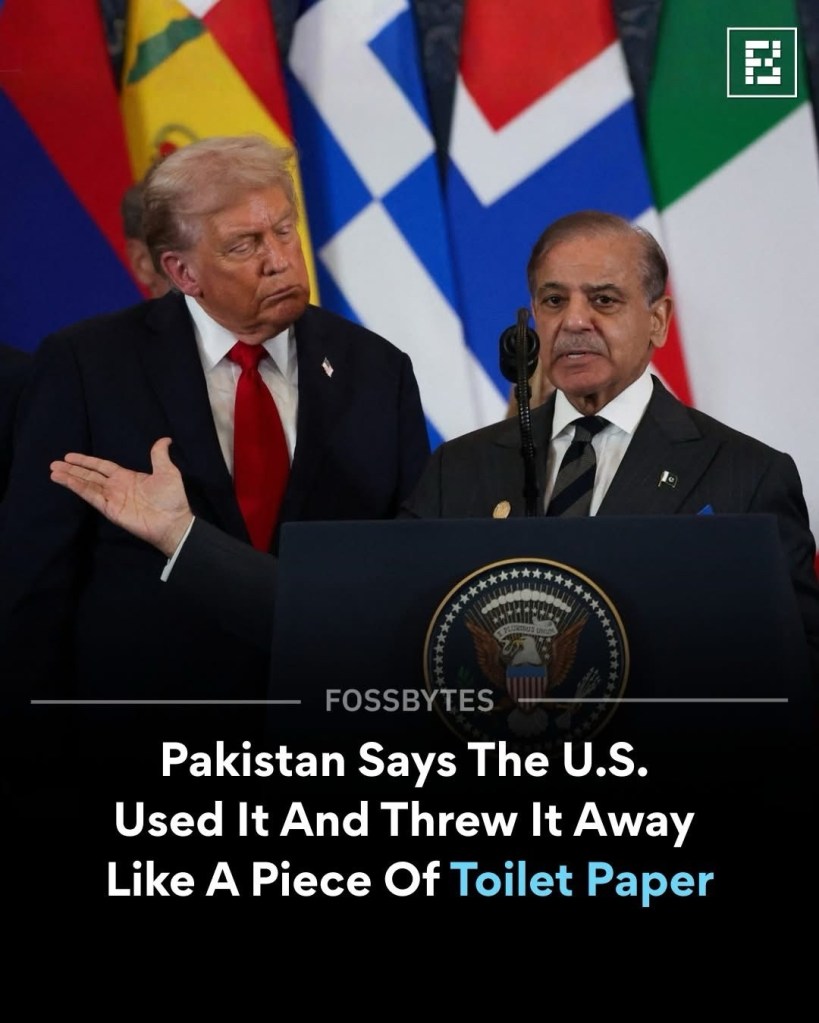
A candid admission of the Defence Minister of Pakistan is cited above. Earlier too he was bold in admitting that Pakistan did dirty work for the US in last cycles of geopolitics. However, these admissions have always lacked honesty. On the heels of first admission Pakistan seemed all poised to yet again do dirty work for the US.
US-Pakistan relationship has all along been transactional. Every time Pakistan opts to side with the US, every time it gets bitten. Seven decades are good enough for the wise to pick up a pattern. Its not that we fail to understand these common sense issues, rather our vested interests have always betrayed our intelligence. Thus the basic question is, are we fooled? Or we ourselves get befooled? Latter seems more applicable.
There is a famous injunction of Holy Prophet (Peace Be Upon Him) “Momin kabhi aik surakh se do baar nahi dasa jata” (A believer is not stung twice from the same hole). Ironically we got bitten so many times. Each time we thought the US was sincere to us, each time we faced the reality. This time the reality dawned so early.
The US has displayed a characteristic and they don’t deserve a blame. It’s those who fall victim to temptations of vested interests who must carry the burden of blame. An honest cost benefit analysis of Pakistan’s alliance with the US will prove that Pakistan lost more and gained less. Still we are incapable and incapacitated to think of cutting this reliance. While the nature is pushing us in another direction, we find comfort, solace and vested interests in sticking to old direction. The world is gravitating to China and iron-clad brother of China seems ambiguous.
The situation in and around Pakistan demands that we should focus on our national interests. Once Sri Lanka faced the scourge of insurgency, Raja Pakase, then President of Sri Lanka gave a model comprising eight principles to win this war. Sri Lanka did win. Two principles read, “hell with the world we will do what is right for the country and we cannot do it without support of neighbors”. Today’s Pakistan may be viewed in context of these tested principles. Though we are wiser than Raja Pakase, however it seems we are bent upon damaging Pakistan while serving our egos and vested interests.
Imperilled Pakistan 2
Imperilled Pakistan
A sore heart prevented me from taking a pen for pretty long time. Sore because of injustice, lack of rule of law, incivility, imprudence and high-handedness in the society. The above cited blog was written in May 2018. Not only what I wished then got missed but I feel we have gone bad to worst. The purpose of my write-up isn’t to cast aspersions or blame someone. In fact the purpose is to show my concern as a patriot and highlight how Pakistan is hostage to egos and vested interests. Biggest wish is that we realise sooner than later and stop damaging this beautiful country. Let the system grow to overtake personalities.
A beautiful and blessed country is shackled by not so desirable attitudes, personal egos and vested interests. A saner mind would be at loss to understand the rationale behind our collective pursuits. Our national energy is getting consumed in unnecessary battles.
Pakistan is unfortunately located amidst a troubled neighbourhood. One side is India which is big but not great. It spares no opportunity for damaging Pakistan. On the second side is dysfunctional Afghanistan which has itself become a gave-yard to earn the title of grave-yard of empires. It has remained disturbed for over 200 years in its modern history. Third side is a sanctioned Iran which brings-in its own part of challenges. Only normal and benevolent neighbour is China. China holds tremendous promises-laden opportunities for Pakistan.
To top it all, again and again the region has come to centre stage of rivalry of giants. First British Empire and Soviet empire locked horns prior creation of Pakistan. Second, US came to give crushing blow to Soviet Empire in finale of Cold War. The region was still reeling out of ill-effects of these conflicts that world witnessed calamity of global terrorism. Once again two giants ie forces of order led by the US and forces of disorder led by AlQaeda were entangled. Max price was paid by Pakistan and Afghanistan while enemies of Pakistan got a hey day. Defence minister of Pakistan lately admitted that Pakistan did dirty work for the West. This admission was expected to mean that Pakistan will not do such a dirty work in 21st Century Geopolitics. However, ground indications show that may be owing to its inherent vulnerabilities Pakistan is once again shying from moving away from the US.
In such a complex and dreading geo-strategic environment Pakistan’s house in order is a critical requirement. Contrarily on internal front Pakistan has moved from bad to worst. In 2017 while writing my book, I mentioned three beautiful convergences which bode well for promising future of Pakistan. Firstly we had won war against terrorism, secondly, CPEC; a positive opportunity came on the horizon and thirdly Pakistan was transitioning towards relatively better democracy. Unfortunately last three years have seen reversal on all three. In last three years a controversial regime change was followed by active hostilities with all three neighbours of Pakistan ie Afghanistan, Iran and India. Prior to ambitious BRI, China settled its disputes with 14 of its neighbours as BRI wasn’t possible without stable external front. Contrarily, Pakistan is vying for CPEC with instability in and around it.
Regime change has left Pakistan divided and agitated. In any setup there ought to be at least one personality or department which is non-controversial and acceptable to all. Such an entity helps in resolving disputes. Today’s Pakistan doesn’t hold any personality or department of that stature and acceptability. Consequently, the fight is on and the country is suffering. For last three years Pakistan is fighting a battle on this front which is turning bad and bad with no end is sight. The situation got compounded due to pulls and pushes of global geopolitics and estrangement with India and Afghanistan. Though we gave a crushing blow to India in May 2025, which checkmated it in conventional domain but it exacerbated unconventional challenges from India and Afghanistan.
All three dimensions ie Sino-US rivalry, estrangement with Afghanistan and vitiated inner front are complementing each other. While first two may not be of our making but third one is definitely of our own making.
Basic strand of strategy is to bring our challenges to as less a number as possible, preferably to one so that one can focus. But ironically we are fighting on all the fronts simultaneously.
Pakistan must reassess its strategic orientation. Alignment with China secures our future albeit it will not be free of challenges. However it will be far better on CBA than alignment with the West (will explain this in another blog). Internally powers in Pakistan must submit to the will of the people of Pakistan as injunctioned by founding father Quaid e Azam Muhammad Ali Jinnah (Allah may bless his soul). Pakistan must be left on auto-mode. Let it self correct itself.
Political temperatures may be cooled down even at the cost of ego. We may prefer victory of Pakistan over own victory. It’s so dreading to see people of KP and Punjab exchanging barbs. It can be disastrous for the federation.
President of Pakistan known as master of reconciliation may step forward and inject some sanity. It’s his national obligation. This division and infighting has the potential to seriously damage Pakistan.
The West which has extricated from the region may be left to rest in peace and Pakistan should collaborate with regional countries to seek stability, growth and development in the region. Over doses of conflict have ruined our body politic. Pakistan should shun any form of conflict within and without.
May Allah bless sympathetic and fair consideration to my thoughts. Allah may guide us in preferring victory of Pakistan over victory of an organisation or individual.
Real Education
Education is a defining part of human life. Human is also called a social animal. It’s the education supported my cognition which transforms an animal per se to a human. Mostly it’s a point to ponder that what is real education?
My teacher at school level (Allah may bless his soul) had defined education as:
- Learning to learn
- Learning to evaluate, and
- Learning to lead
There is a common debate on difference between qualification and education. Qualifications get us jobs whereas education transform our personalities. In my view basic attribute of an education ought to be that it impacts the personality of the subject. Any much of education which fails to have an impact on personality can be anything but education. Possessing knowledge doesn’t mean that the possessor is educated. Thus we may find a PhD who has abundance of knowledge but still may be uneducated as his knowledge failed to imapct his personality.
Above cited video gives another interesting dimension of education.
Trump’s Game of Chicken
Watching President Trump’s diplomacy, I am reminded of the “Chicken” game. It has been popular in many countries particularly in the US. It is played by two drives each in a car. They drive into each other with a possibility of a fatal crash and see which one of the two chickens out. The one that swerves is called Chicken and the one who stays the course is the winner. In this game, both players before start of game commit some gimmicks to befool the other. They may wear dark glasses, make wind screen muddy, project themselves as insane, play loud music. All these gimmicks are made to make the opponent believe that crash might occur inadvertently. So the weaker at heart chickens out.
There are certain strategies employed by each player to defeat the other like:
- Commitment Strategies:Players can attempt to commit to not swerving, making it a credible threat that the other player must react to. This might involve actions that make it seem impossible to swerve or signaling a strong resolve not to.
- Preemptive Actions:Launching an initiative before the opponent has a chance to react can force them to play defensively. This can create a situation where the opponent is reacting to your moves, rather than initiating their own
- Brinkmanship: Players might push the situation to the brink of a negative outcome (like a crash) to try and force the other player to concede.
- Mixed Strategies:Players might adopt a strategy where they sometimes choose one action and sometimes another, making it harder for the opponent to predict their behavior.
Bertrand Russel wrote this about this game:
Since the nuclear stalemate became apparent, the governments of East and West have adopted the policy that Mr Dulles calls ‘brinkmanship’. This is a policy adapted from a sport that, I am told, is practiced by some youthful degenerates. This sport is called ‘Chicken!’…..As they approach each other, mutual destruction becomes more and more imminent. If one of them swerves from the white line before the other, the other, as they pass, shouts ‘Chicken!’, and the one who has swerved becomes an object of contempt. As played by irresponsible boys, this game is considered decadent and immoral, though only the lives of the players are risked. But when the game is played by eminent statesmen, who risk not only their own lives but those of many hundreds of millions of human beings, it is thought on both sides that the statesmen on one side are displaying a high degree of wisdom and courage, and only the statesmen on the other side are reprehensible. This, of course, is absurd. Both are to blame for playing such an incredibly dangerous game. The game may be played without misfortune a few times, but sooner or later, it will come to be felt that loss of face is more dreadful than nuclear annihilation. The moment will come when neither side can face the derisive cry of ‘Chicken!’ from the other side. When that moment comes, the statesmen of both sides will plunge the world into destruction.
Over a period of time President Trump has projected himself as brash, aggressive, bold, dauntless, and brink-man. He by design raises the bar for the opponent to make him acquiesce to the target the intended by him. In case of India there is a clash between Geopolitical interests and economic interests. President Trump for the time being is focusing more on the latter. US can never afford to lose India owing to its strategic rivalry with China. Although it seems the US has lost faith in capacity of India to compete China. Notwithstanding that, India still has great value for the US.
It seems presently President Trump is focusing on immediate objective of weaning Pakistan away from China. This objective if achieved can serve better to compliment overall objective of containment of China. Once this objective is achieved the US will once again shift to rely on India for further building on this objective.
Pakistan has to walk a tight rope. It can annoy none of the two ie the US and China. However, its very evident that future of Pakistan lies with China. All depends how well can Pakistan do the balancing act in diplomacy while safeguarding its national interests.
Inglorious ‘I’s
9/11 happened in the first year of 21st century and that of second mallenia. Terrorist attack on the World Trade Centre was the last of the eighteen events that altered the path of human civilization ever since 1899. This was an act of aggression against the sole superpower of the world. Defeat of competing superpower i.e., the Soviet Union had made the US arrogant, over-confident and complacent. The attacks caught the US in total surprise. The prestige and ego of the sole superpower was badly mauled. It was the biggest shock to the prevalent world order. Simon Jenkins says, “No single figure since the Second World War has made so profound an impact on world events as Osama Bin Laden”. 9/11 changed America fundamentally. It was the new “Pearl Harbour” for them. The US administration which was following “Isolationist” policies got committed to robust overseas intervention. 9/11 also illustrated the dark side of hither-to-fore buzz word of ‘Globalization’. It gave birth to an unprecedented coalition of revulsion. The world felt sympathetic to the US as a victim and rallied behind it to pay back to the perpetrators. Non-state actors came to the fore who had found safe havens in poorly governed states and started calling the shots. Hosting state had no control over these elements and neither had the capacity or capability to exert control over them. The event of 9/11 also gave birth to global war on terror. Prior to 9/11, wars were fought between states, but after 9/11, based on UN Security Council Resolutions 1368 and 1373, war against non-state actors became a possibility. The concept endowed states with carte blanche to invade other states that potentially harboured terrorists. The intransigence of the utterly embarrassed sole superpower lumped genuine freedom struggles also with terrorism.
9/11 also brought an opportunity to the Inglorious ‘I’s ie India and Israel. Two arrogant states got a hay day to use bogey of terrorism for whipping opponents. Freedom struggles in Kashmir and Palestine were worst affected. Both India and Israel in cahoots with each other began to employ military might to not only crush these freedom struggles but also force the legitimate supporters to abandon their support. For over two decades this actual axis of evil, stage managed incidents, fabricated narratives and acted boorish to achieve nefarious designs. They held no bars in violenting global ethics, norms, conventions and morality.
Months of May and Jun 2025 have been defining months. In the month of May Inglorious India followed its well practiced playbook, conducted falseflag operation, framed Pakistan and launched unprovoked aggression against the latter. India acted arrogantly, intansigent, boorish, condensending, fabricated narratives and attempted to bite Pakistan. With blessing of Allah, support of China and outstanding performance of PAF, India got knocked out within first few hours of hostilities. Beyond those initial four hours it was mere accentuation of India’s vulnerabilities. The conflict left telling impact on multiple accounts.
Firstly, the US strategic partnership with India came under stress. The US which anticipated dressing down of Pakistan at the hands of India was compelled to broker a cease fire once chips were down. The US resolve to support India buckeled under pressure. Axis of US-Israel-India got beaten, humbled and exposed.
Secondly, a new troika emerged in the region comprising Pakistan, China and Bengladesh. India should have realised by now that while her allies are distant powers, this troika is surrounding India. India is now getting the taste of three front scenario – more menacing than two front scenario in which India embroiled Pakistan in last two decades.
Thirdly, all good things happened for Pakistan and all bad things happened for India. Pakistan got united, emerged as a confident, self-assured and resilient regional power. On the other hand, decades old playbook of India got exposed, US lost faith in India for expected role of India in the region, got isolated and Indians lost faith in its media, government and armed forces.
Moving to the other theater, the second Inglorious ‘I’ ie Israel launched unprovoked aggression against Iran. In this case arrogance and intransigence was many notches higher than that of India as the sole superpower has been inalienable veritable arm of Israel. They are extention of each other. The outcome was out of wildest dreams of the two. They launched aggression with mindset of vanquishing Iran in weeks. However, yet another embarrassment was waiting for them at the foot hills of Elburz Mountians. Iran which has withstood an onslaught for 4.5 decades unleached its national pride and resolve to humble the self-proclaimed mighty powers. Within a month the sole superpower was faced with yet another stark reality of beating of its closest ally at the hands of a resolute nation. The US had to broker another ceasefire within a month to save its love-bird.
Both these wars had serious implications for Pakistan. If war with India had prolonged, Pakistan’s economic, political and security vulnerabilities would have accentuated . Closure of hostilities within short time was a huge blessing of Allah. The war benefitted Pakistan in many ways but most prominently it put Pakistna on a track it was shying away. Friend and foe were clearly identifiable. Importance of Pakistan for China became crystal clear. An arrogant and intransigent, self-proclaimed regional policeman and net security provider ie India was cut to size. Pakistan’s future has become more secure and Sino-Pakistan relationship has further cemented.
On other hand, if Iran was defeated and a pro-Israel government was installed in Iran, Pakistan would have faced a nightmare. Inglorious ‘I’s would have surrounded Pakistan. China’s ambition of accessing Indian Ocean through CPEC would have been quashed.
In nutshell, outcome of both these wars have been promising for Pakistan, China and the region. These have put to rest the two Inglorious ‘I’s. Legitimate freedom struggles will get new lives. Eastern Bloc has emerged more confident and Western Bloc seems stressed. CPEC seems secured and future isolation of India seems more likely. Transition of conflict-prone, Indian-centric South Asia to growth-prone, Chinese-centric South Asia has become more likely.
If sense prevails and there are no more hostililities, the region will do better under Chiense influence and lesser influence of Western powers.

