Pakistan and Afghanistan were worst affected in SA due to the 20th Century Geopolitics. Yet again 21st Century Geopolitics is knocking at our doors. My blog of 2021 has been cited above as a reference. This will give a clear idea about projections then made and unfolding of the events now. Such moves can only be countered through cohesion within the region. It is hoped that once again Pakistan and Afghanistan are not made to play the dirty role, we have got used to, due 20th Century Geopolitics. My blog cited above and the article of Dr Fiaz Shah, appended below will provide good insight to the reader. Our nuclear assets being primary target don’t fall in my assessment, however, central position of Afghanistan provides good leverages to the US vis-a-vis China and its ambitions namely BRI and CPEC as well as other regional countries. Holding Bagram is a smart move by the US but it portends another cycle of conflict in the devastated region. Hope better sense will prevail
US in Bagram – Future Watchdog Over Pakistan by Brig Dr Fiaz Shah
The reactivation of Bagram Airbase under a potential second Trump administration has ignited geopolitical concerns, particularly regarding its implications for Pakistan. The strategic significance of Bagram extends beyond Afghanistan—it positions the United States within immediate striking range of Pakistan’s nuclear assets. This paper explores why the US negotiated with the Afghan government to regain control over Bagram, the potential objectives behind this move, and the implications for Pakistan’s sovereignty and security.
Why Did the US Bargain for Bagram?
Strategic Location & Regional Control
Bagram Airbase, located in Parwan Province, Afghanistan, is the largest US military base in the region, offering proximity to both Central and South Asia. The base provides a logistical hub for surveillance, rapid deployment, and regional power projection. Given its close proximity to Pakistan, retaining control over Bagram ensures the US has a forward-operating position in case of a geopolitical crisis in South Asia.
Counterterrorism or a Geopolitical Play?
While the official narrative suggests that Bagram is needed to counter ISIS-K and prevent another resurgence of extremist elements in Afghanistan, a closer look suggests a broader agenda. The resurgence of the Pakistani Taliban (TTP) and the Balochistan Liberation Army (BLA) within Pakistan provides a convenient pretext for US intervention, allowing Washington to justify an expanded intelligence and military footprint.
Pakistan’s Nuclear Arsenal – The Real Target?
Pakistan’s nuclear weapons program has long been a concern for US policymakers. With an estimated 170+ warheads and one of the fastest-growing arsenals globally, Pakistan’s nuclear capability remains a strategic asset and a liability in Western security assessments.
Prominent figures in Trump’s circle—including Mike Waltz, Pete Hegseth, and former CIA Chief Mike Pompeo—have consistently voiced concerns about Pakistan’s nuclear security. The potential reoccupation of Bagram strengthens US operational readiness should Pakistan’s internal stability deteriorate.
Bagram’s Role in a Potential Nuclear Intervention
A Three-Stage Playbook
The reactivation of Bagram appears to follow a familiar US intervention script:
Step 1: Destabilization – Increasing terrorist attacks (TTP, BLA) weaken Pakistan’s internal control and create an international narrative of fragility.
Step 2: Media Narrative Building – Western think tanks (e.g., Atlantic Council, RAND Corporation) publish reports highlighting Pakistan’s “nuclear insecurity.”
Step 3: Military Intervention – Under the guise of “securing loose nukes,” the US leverages Bagram to launch rapid-response operations.
This approach mirrors the intervention in Libya, where Western intelligence reports on WMD threats justified regime change.
Trump’s Direct Threats
During a March 2025 rally, Donald Trump explicitly stated: “We need Bagram back to watch the bad guys next door.” Given Afghanistan has no nuclear capability, the reference clearly points toward Pakistan.
Who is Orchestrating the Strategy?
Several key figures within the Trump camp align with this aggressive stance toward Pakistan’s nuclear program:
Mike Waltz (National Security Adviser) – Former Green Beret advocating a forward military presence in South Asia.
Pete Hegseth (Potential Defense Secretary) – Supporting the deployment of rapid-response teams to Bagram for “counterterrorism.”
Mike Pompeo (Former CIA Chief) – Previously involved in covert nuclear surveillance programs, pushing for stronger interventionist policies.
What’s Next for Pakistan?
Immediate Security Implications
Pakistan’s military and intelligence community must anticipate and counter potential moves to destabilize the country under the guise of counterterrorism. Ensuring robust nuclear security and countering the narrative of instability is crucial.
Diplomatic Maneuvering
Pakistan must proactively engage with regional and global powers, particularly China and Russia, to counterbalance the US presence in Bagram. Strengthening ties with the Shanghai Cooperation Organization (SCO) and expanding defense pacts can deter unilateral interventions.
Strategic Defense Measures
Increasing internal intelligence operations to preempt potential destabilization attempts.
Enhancing nuclear security protocols and ensuring transparency with friendly nations to counter misinformation.
Strengthening border security with Afghanistan to limit external influences that may fuel instability.
The US return to Bagram is not just about Afghanistan—it is a calculated move aimed at maintaining strategic oversight over Pakistan. The increasing narrative around Pakistan’s nuclear “fragility” aligns with past interventions, making it imperative for Pakistan to adopt a proactive strategy in defense, diplomacy, and information warfare.
As tensions rise, Pakistan must recognize that the clock is ticking. A misstep in internal security or governance could provide the justification needed for a US-led intervention from Bagram. The battle is not just military—it is also a war of narratives, and Pakistan must ensure it does not fall victim to a scripted downfall.
There are many great examples but Aussies always stand tall. Once it comes to moral issues, they hold lofty standards. Almost a decade ago, Smith their cricket skipper was caught cheating on the field. He was seen shedding tears on TV and begging for people’s forgiveness. Simply amazing and mind boggling for the people in Pakistan. Conversely, like many other nations, Pakistan stands on the other extreme. We follow corruption, we condone corruption, we appreciate corruption. Unchecked for long, corruption has seeped deep into our bones.
Undoubtedly the biggest challenge that Pakistan faces today is moral degradation and decay. We do corruption with our heads high, hearts at peace, zero shame and taking it as our right. In our system the one who doesn’t do corruption is taken as insane and misfit.
Diagnosing this ailment, one can think of two glaring aspects. Corrupt, indifferent, un visionary, self serving and inapt leadership. Leaders are supposed to set standards and serve as a role model. They serve as role model for bad practices. Secondly, prolonged conflict (most of which of paid mercenaries) has damaged us in many ways. The most serious damage has been to our national character causing a societal decay and moral degradation. Our systems and institutions have badly deteriorated. All dimensions of the state were far better 50 years ago. Our journey has been in reverse gear. Ill begotten money, easy money, negative knowledge (meant to do bad things), breed of parvenue, sycophants and opportunists have played havoc with this nation.
The overall standards of morality are abysmally low. There is zero shame, guilt or fear of law; attributes needed to check human actions. Corruption and bad practices give greater dividends than honesty and good practices. It is appalling that not a single contestant of 2024 elections gracefully accepted his defeat whether big or small wigs. Heard about elections in Malaysia, the largest winning party was unable to form government. The opposition jointly could, but displaying higher morality, opposition declared that largest winning party had the moral authority to form the government. A Muslim country we could emulate. Can we think of such like morality in Pakistan. Conversely, the losers are ruling.
Damages caused over half a century will not be easy to eradicate. It will need realisation of top level and sterling commitment. Treatment of societal issues warrants employment of social scientists like a doctor treats a human. Some actions need of the hour are:
a. Leaving country on auto mode, let the people decide who deserves to rule
b. Eradication of strategic blunders
c. Respect to constitution and rule of law through head and heart
d. Social reforms on war footing
e. Teaching character and good practices at mosque and schools
f. Ruthless punishments to offenders
g. Higher punishments for higher position holders than a common man
h. Instilling pride and honour in doing good things
i. Greater emphasis on women education for them being future mothers
j. Emergency to put house in order based on established standards of ethics and norms as enshrined by the religion
k. Teaching injunctions of Islam, Prophet PBUH, and founding fathers
l. Greater focus on third generation
m. Revival of shame, guilt and fear of law
n. Create harmony in society
It will seem a tall order, a wishful thinking, a day dreaming; but we have take a start. If leaders decide to correct themselves and become people centric, each day will be a new day.
Many a times I felt myself to be hyper critical of our society. I have written numerous blogs on the subject. This video resonates my feelings. Societies are driven by Shame or Guilt or Fear of law. All three have gone missing in our society.
Today needed a vaccination for holy journey of Umra . Had no option but to buy injections from “black market”. The corruption has gone so rampant and deep routed that turn around seems impossible. Best way may be that we pick up courage to “blame and shame” and we collectively rise to throw out bad rulers; replacing them with honest and sincere ones.
Allah may bless us all a realisation to understand, will to change and ability to contribute in whatever capacity we are. We need to reinvigorate shame, guilt and fear of law in our society. A high quality society needs minimal laws for its functioning as all are self aware, self conscious, self disciplined and self accountable. A low quality society needs legislations and laws for every mundane dimension as all are self centred, greedy, and corrupt.
Ran into a video which validates my hypothesis. In my view, the West has ruled the World by domination in three areas:
Technology
Economy
Information Dominance
In case of first two China is competing well with the US but in case of last one, China is no where near the US. Since our childhood we have seen domination of electronic and print media by the US. BBC, CNN, Fox News, Newsweek, Times, Economist, Readers Digest; all come from the West. There is no rival both in electronic and print media. Any country or ruler who tried to challenge the West in these areas was shown the door. Al Jazeera and RT emerged as challengers for alternate views. RT has been put under sanctions and Qatar has been pressurised to control and regulate Al Jazeera.
It’s highly essential for China to compete in information dominance. Internal dynamics of China are not conducive for open media while internal dynamics of Pakistan do permit an open media. The former has the money whereas the latter doesn’t have. A media house of the stature of Al Jazeera and RT is worth consideration in Pakistan as part of the CPEC. It will help to counter misinformation and wrong narratives being propelled by the West.
Thought of writing a blog but was stuck for want of a suitable title. A friend suggested this one.
In 2016 a former UNDP Director Marc Andre Franche took an aim at Pakistan’s elite in scathing final interview (the link is cited). In his words, “only way a critical change could happen in the country was when the influential, the politicians and the wealthy, would sacrifice short term, individual and family interests for the benefit of the nation.” He further said, “You cannot have an elite that takes advantage of very cheap and uneducated labour when it comes to making money, and when it is time to party it is found in London, and when it’s time to buy things it is in Dubai, and when it’s time to buy property it invests in Dubai or Europe or New York. The elite needs to decide do they want a country or not.” He was critical of landowners, gated-communities, media and mass-exodus of youth. He only praised KP government for decent people-centric laws.
I am also reminded of Dr Abul Kalam Azad who mentioned in his book that prior partition of India once congress announced policy of land reforms, feudal lords of regions which comprise today’s Pakistan said, “let’s make another country where there are no land reforms.” The feudal lords are still ruling this country. The common man’s purpose for creation of Pakistan was “La Ilaha Illalah” but that of feudal was “no land reforms.”
Eight years have passed since Mark Andre Franche said prophetic words. One thing is glaringly emerging with each passing day that a fight is going on between the elite and the street. Elite is not willing to give up what it has acquired in seven decades. Elite has rather rallied together against the street to safe guard its interests. With change in personalities no change is being seen in policies. Elite is getting ferocious with each passing day. The street on other hand desires to have its say.
Every saner mind is grappling with a question that, why the system has gone berserk? One possibility is that the powerful have decided to transform this society from open to a closed society, where fear rules and no one dares to question like China and Arab World. It’s a tough job but they seem to be resolute. On another account fear is also in play for pursuits of high offices of Pakistan. The pursuits which were earlier driven by greed now have fear as another driver.
The street is running out of options. Its patience is running thin. Its vote becomes inconsequential, its peaceful protest is ransacked, its voice unheard, its opinion doesn’t matter. Where the street goes from here. Will it take up arms? Will it bear all this? Will it react violently? One thing is for sure the seeds of thorns will never bear fruits. What we are sowing we are bound to reap, sooner or later
Another valid question is, why it’s happening this way? Today’s political dispensation is non-representative of people of Pakistan. It has got to power corridors through machinations, deceit and stealing election results. Few personalities at the helm of affairs like Faisal Wawda and Mohsin Naqvi are not even political personalities. They have nothing to lose. The Government on the whole and these non-political powerful personalities have zero respect and regards for the street. The present system is viewing the street as enemy, since it didn’t vote for them. Political leaders have on record questioned awareness and wisdom of people of KPK.
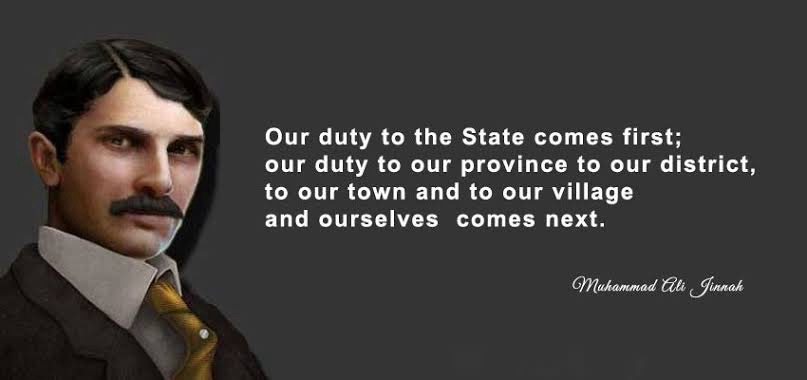
It’s era of social media which has both strengths and pitfalls. It’s hard to hide truth while it’s equally easy to spread lies. It was a battle which seems over but the war is still on. Let’s follow in true letter a spirit Quaid e Azam injunction,
Found an interesting video that incited me to compare Pakistan’s 75 years with that of China. China’s story is positive with a lot of growth whereas Pakistan’s story is not so happy. The factors making these opposite stories are contrasting in themselves.
The start of the journey of the two countries was apart by one year. Pakistan gained independence in 1947 and China in 1948. In particular, China’s flight of growth and development started in 1978 when it liberalized its economy and registered tens of thousands of small businesses. Conversely, Pakistan’s downward flight started in 1979, when it was presented with an opportunity of pivotal role in global geopolitics. From 1978-2018 in four decades China grew its economy 91 times and GDP 25 times. In the same period Pakistan’s economy suffered badly.
The biggest contrast in the stories of the two countries lies in the prevalence of conflict. Pakistan along its 75 years faced almost perpetual conflict. War in the first year, next in the 18th year, and still next in the 24th year. These wars were interspersed by skirmishes, uneasy peace, and minor conflicts. The war in the 24th year ie the 1971 war, dismembered the country giving mega shock of five shocks; ideological, political, territorial, military, and moral. Pakistan just had 8 years to reel out of these shocks that the USSR moved into its neighborhood in 1979. Pakistan helped the US to win the Cold War by suffering immensely. Pakistan was faced with the hard reality of settling the mess created in and around it. The finale of the Cold War in Afghanistan had sown the seeds of the next war. 13 years later, 9/11 occurred and Pakistan was presented with yet another pivotal role in global geopolitics. In the middle of these geopolitical cycles was Kargil war. These global wars brought certain pros but huge, immeasurable and the worst cons.
Conversely, China fought only war with India in 1962.
China had a conducive environment for growth and development whereas Pakistan had an antithetical environment for growth and development. China chose a political system and stuck to it, Pakistan continued with experiments. China had a continuation of policies (14 Presidents) and Pakistan had fast-changing and mercurial policies (37 rulers). China’s leadership comes from the grassroots level, and Pakistan has dynastical parachuted leadership. Chinese leadership has been visionary while that of Pakistan has been self-serving. China had no colonial legacy whereas Pakistan suffered from it. China improved its relations with 14 neighbors. Pakistan has estranged realtionship with neighborhood.
A question may arise, how did India progress with a similar conflictual environment? India had a better foundation of institutions, leadership and resources. India remained non-aligned in tussle of superpowers. India had continuation of policies. Being a larger country India could better withstand losses due to conflicts. India has a superior geography due to its box-seat position in the Indina Ocean.
Now let’s see how prolonged conflict has impacted Pakistan. Alignment with the West and pivotal role in global geopolitics brought in easy money. Initially, it was a blessing to counter larger enemy but later it became a curse as body politic of Pakistan got used to it. Easy money depleted the motivation to work hard.
Ibne Khaldun had given a 7-stage cycle for the evolution of civil society from medieval to a prosperous society. External or internal interjections in the form of conflict reverse, retard or slow this process. Afghanistan has been impacted more severely and Pakistan too has been impacted badly. Conflict coupled with easy money has produced a breed of sycophants, parvenu, opportunists, and greedy people. They see talent as threat to them. Thus no merit, no justice, no fair play.
Besides material losses, these prolonged conflicts have torn our social fabric and destroyed our national character. Basic positive attributes of a society have eroded. Materialism has crept in so much that money matters more than anything else. The institutions which were already not well founded got further eroded.
Given its sufferings of the past, Pakistan should mitigate conflict in and around it. What it cannot do itself, should do with support or friends. Pakistan should not become part of other’s conflicts and it should shun the lust for easy money. Pakistan should improve relations with neighbors even at the cost of compromises. Pakistan can benefit a lot by aligning with China and following its model of growth and development
I hold a doctorate on Strategic Security Management of CPEC. It involved identification of threats to CPEC. Above video prodded me to write this blog. It’s my considered opinion that if Pakistan loses opportunity of CPEC it will be biggest disservice to our future generations. IPakistan seems to be victim of Sino-US rivalry. shall support my contention based on few main arguments.
1. For its entire history, Pakistan has remained aligned with the West. All of its systems ie political, military, economic, judicial, and educational are based on Western knowledge. Pakistan is now faced with the stark need for strategic reorientation from the West to the East. This reorientation though need of hour warrants colossal efforts and will and is laden with challenges as the rise of China is being contested.
2. Alignment with the West has kept Pakistan on track of fighting and destruction. In 20 Century geopolitics Pakistan played pivotal role and suffered immensely. Only in GWOT the losses comprised that of blood ie 80k dead and triple than this maimed, financial ie $ 123 B, infrastructure and above all national character. On the whole, present state of Pakistan doesn’t speak well for this alignment of the past.
3. 21 Century Geopolitics has brought new opportunities and challenges for Pakistan. Towards end of decade of 2010s, emergence of CPEC’s opportunity converged with Pakistan’s winning of war on terror and a positive political transition. However, now there are reversals on all three accounts. On other hand, India has emerged as natural ally of the US and conduit for Sino-US rivalry-a hallmark of 21 Century Geopolitics. Logically speaking India would be now expected by the US to play a similar role in 21 C Geopolitics as Pakistan played in 20 C Geopolitics. Pakistan can thus achieve a break from fighting and destruction.
4. Indian Ocean is projected as Centre stage of rivalry for 21 C by Robert D Kaplan. Importance of IO was mentioned by Mahan a century ago as well as Admiral Stravidis recently. Through CPEC China gets direct access to this future playground. CPEC can convert China from one Ocean to two Ocean country and also mitigate Malacca Dilemma: thus Pakistan’s immense strategic importance though this time for good reasons.
5. Pakistan has remained a security state for its entire history, which has left many ill-effects. CPEC can transit Pakistan from a security to an economic state. A positive track is far better than negative one as if nothing more we can save the losses for being on negative track.
5. The US is a distant power whereas China is a neighbor. Relations with the US have been transactional and G2G. Relations with China have been P2P and all weather as China has stood by Pakistan through thick and thin. The US is a waning and China is a waxing power. Future of Pakistan lies with China.
5. South Asia on the whole is least integrated, the most impoverished and conflict prone region of the world. Prolonged conflict has left South Asia in bad state. CPEC is seen as Marshall Plan for conflict ravaged South Asia.
6. Federation of Pakistan seems loosely held. One part starts shaking after the other. CPEC will solidify the federation. China’s stakes will be integrated into regions claimed by India. It’s this realisation which compelled India to annex and consolidate IOK as China will become a strong stakeholder incase of GB and AJK. The same is highlighted in the above video.
7. Pakistan’s internal instability was foreseen and is becoming biggest hurdle to CPEC. It’s rather due to the contestation of CPEC by the inimical forces. Once China laid out BRI it resolved disputes with its 14 neighbours. Pakistan also needs to workout cooperative solutions with its neighbours for the bigger objective of CPEC which will benefit all.
8. It’s high time Pakistan should take care of own interests. Sri Lanka won battle against insurgency based on the Rajapaksa model. Second principle out of 8 said the world can go to hell we shall do what is right for our country…. A food for thought for Pakistan. Another principle was based on keeping neighbors on board. Pakistan should also work in cooperation with the neighbors.
9. Pakistan and China have their own motivations for CPEC. It can benefit both the countries and the region at large. While China has strategic gains, Pakistan is likely to gain economically.
In April 2023, I had raised a hypothesis, “Human intelligence is meant to lead sapiens to self destruction”.
Why this thought? I feel Sapiens are the only creation of Mother Nature which is anti nature. Its pursuits for comfort, living, mobility and ease of life run tangent to demands of the nature. Humans need dwellings, transportation, infrastructure, storages etc etc. All these activities affect the nature adversely. In the beginning, the humans impacted local systems like affecting a stream, cutting trees, polluting surroundings. However, after two-hundred-thousands-years’ existence (a minuscule of total life of universe ie 13.6 billion years) the sapiens are impacting global systems. Sapiens are fast depleting global resources and setting-in imbalances. This is humongous impact in too little time. Mother Nature took 13.6 billion years to make this universe liveable for its the best creation. Conversely same creation in mere two hundred thousand years of its existence has alarmingly depleted natural resources and created imbalances. How much impact sapiens will create in next two hundred thousand years can be conveniently guessed.
Yuval Noah Harari in his new book Nexus has brought out similar hypothesis that Sapiens are on a course of self destruction. YouTube video of renowned author has been cited above.
Mother Nature is best aware of its designs. Will doomsday be brought by external forces or internal forces? I foresee humans will themselves create such imbalances in finely balanced universe which will set in the process of destruction of our galaxy only or the complete universe. God is all aware all wise
Thucydides was a Greek historian and general 460-400 BC. He has been called the father of school of political realism. “Thucydides trap” was though coined by American political scientist Graham T. Allison in 2012 but was from the concept given by Thucydides. He had predicted outbreak of Peloponnesian War between Athens and Sparta in 431 BC purely because of Spartan’s fear of the growth of Athenian power.
Based on Thucydides concept, it is now said that an established power will always see an emerging power as a threat. Allison in his book, Destined for War (Can America and China escape Thucydides Trap?) has mentioned that out of 16 historical instances of an emerging power rivaling a ruling power; 12 ended in war. We are witnessing 17th transition of power from the West to the East in general and from the US to China in particular. The world is holding its breadth, keeping fingers crossed that 17th transition doesn’t end in a war.
The above cited video hypothesises a war between the West and the East. It has mentioned arraying of various countries in two contesting poles. It says the West wants to wage a war against Russia, China and Iran. Turkey, Saudi Arabia, Pakistan and India will be used by the West to fight this war. Particularly it talks of Pakistan and Saudi Arabia will be meant to fight Iran.
It’s said that forewarned is forearmed. On one hand this video should raise our concerns and awareness as regards the West’s possible plans about us but on the other hand I see it as a mere conspiracy theory.
Rise of China for sure will not go uncontested. Many of efforts of the West are already visible and in play. I personally assess extremely low possibility of a war (as we perceive it ie a duel involving fighting with military munitions). There would be war but of different character like trade war, low intensity conflict, economic strangulation etc etc. The destructiveness of the modern means of war will itself deter a conventional war. No one will like to see total annihilation which is possible throw thermonuclear devises.
It is also said that hope for the best and remain prepared for the worst. A country like Pakistan can least afford another cycle of conflict based on global geopolitics. In 75 years’ life of Pakistan twice it was made to play the dirty role in global geopolitics. This role has virtually devastated the inner core of the country. Human loss, financial loss, loss of national character, creeping in of materialism and easy money have been few of damning curses faced by the country. Amongst many attributable factors, global geopolitics of 19th and 20th century are a major contributing factor to the present poor state of the country.
Pakistan should not side with the US for 21st century geopolitics. China has been our time tested friend and a neighbour. Whereas the US is a distant power which has mostly seen us as a client. Future of Pakistan is associated with China. Pakistan is critical for Chinese ambitions and China is critical for Pakistan. The sooner we decide upon our strategic direction the better it will be. Allah may guide us well.
Pakistan as a state and decision makers of Pakistan are struggling to grapple with impact of social media. A book review relevant to the subject is posted here for the readers. Assuredly, it will be worth your time.
WAR IN 140 CHARACTERS
(Book Review by Dr Muhammad Samrez Salik)
The book ‘War in 140 Characters’ is permeated with the theme ‘How Social Media is Reshaping Conflict in the Twenty-First Century’. David Patrikarakos has authored it. It was published in the US in 2017 by Basic Books, a subsidiary of Hachette Books Group, Inc. The hard-bound book of 301 pages has a high standard of printing, quality paper, and fine binding.
David Patrikarakos is a London-based journalist and an alumnus of Oxford University. He is the author of Nuclear Iran, The Birth of an Atomic State. He is also a contributing editor at The Daily Beast and Politico. He has also written for The New York Times, Financial Times, and Wall Street Journal, among many other publications. His media background, coupled with his insightful coverage of war zones from Congo to Ukraine, garnered his prowess for evaluating the impact of social media on modern conflict. The book reaffirms David Patrikarakos’s credentials for writing on this momentous subject. It is a well-researched book annotated by fifteen paged notes. The book is divided into eleven chapters. The introduction of the book, as well as the conclusion, covers conceptual aspects. The book is handy for war strategists, war practitioners, media managers, and narrative builders, as well as for academicians and planners. Its factual, easy, and non-technical parlance makes it even more palatable for laymen. The evolution of warfare has been an ongoing process.
The nature of war is constant; the character of war adapts itself to the zeitgeist of the time. The drivers of conflict include economy, technology, tactics, and grievances. The advent of mass media in the last few decades, in general, and the recent phenomenon of social media, in particular, is influencing all dimensions of human life. There is a consensus among the experts on how and why social media is transforming human behaviour, attitudes, and perceptions. Many students who have been involved in conflicts and wars have keenly observed the impact of social media. In this context, the book is the first authentic, comprehensive, and palatable material on the subject. The book is about the study of the changed conduct of war. It is also about stories, the narratives of conflicts and conflict of narratives. The modern means of conflict are taking us closer to Sun Tzu’s dictum, “To subdue the enemy without fighting is acme of skill”. Social media has provided a means to build narratives, perceptions, and sapping of will, enabling us to subdue the enemy without fighting.
The author argues that social media has fundamentally changed the character of war and blurred the line between the battlefield and political discourse. Facebook posts and tweets are increasingly emerging as sources of information and determine who wins the narrative. In today’s world, the narrative is what largely determines victory. Military muscle alone does not suffice; wars are evolving every day, but today, a new element has entered them: first-hand information sent by people to inform the world and sometimes change the narration of events. The author understands how social media drives operations in today’s undeclared grey zones of conflict and sets the conditions for the reader’s understanding of the modern operational environment. Key conceptual aspects are:
Social media has opened vital communication spaces for individuals once controlled exclusively by the state.
More than a war fought by tanks and artillery, it matters who wins the war of words and narratives.
Within the ambit of the Hybrid War, social media has gained the extraordinary ability to endow ordinary individuals, frequently non-combatants, with the power to change the course of the physical battlefield and its discourse.
The narrative dimensions of war are arguably becoming more important than its physical dimensions.
War, as a military fight distinct from peace, still exists. However, the general tendency, driven by the information revolution, is away from that paradigm and towards open-ended networked conflicts that occupy a grey zone between war and peace.
Homo digitalis is a new type of hyper-empowered individual, networked, globally-connected, and more potent than ever before.
They can actively produce content on social media platforms with almost no barrier to entry.
They can form transnational networks Using [various] forums.
They are especially dangerous for authoritarian states.
If you don’t understand how to deploy the power of new media effectively, you may win the odd battle, but you will lose a twenty-first-century war.
Social media platforms now spawn a political reversal: a regression from centralised communicative modes to an earlier age’s more chaotic network effect.
Social media is both centripetal and centrifugal. It shatters unity and divides people in two overarching ways. The first is obvious. It sets them at loggerheads as direct engagement between opposing camps becomes more accessible. The second is more insidious. Most of the populace gets news from social media.
Social media platforms are not impartial; they are capitalist enterprises designed to profit from their users.
It is both a force for good, bringing greater transparency, and a force for evil, destabilising.
It has brought the post-Truth Era, which denotes circumstances in which objective facts are less influential in shaping public opinion than appeals to emotion and personal belief.
Tweets are replacing metal bullets.
The book can also be reviewed in the context of war theories, grouped into psychological, anthropological, sociological, information, economic, and Marxist theories. Clausewitz’s Trinity of Military, Government and People also changes its complexion. While the military remains the primary fighting tool, the government controls it, and people support it. In conflicts before the advent of social media, the military operated in a confined space of governmental control and with people’s support. The mass media, in general, started eroding control of governments in the decade of 80s. The advent of social media has further eroded this control. About people’s support, it is now transcending the borders of states and even regions. People worldwide have started affecting the conflict rather than those of belligerent states. Media and social media have occupied a significant space in this Trinity. The following postulates can be discerned:
Given Psychological Theories, social media impacts the psychology of the masses, decision-makers, and leaders. EFM Durban and John Bowlby postulated that war is innate to human nature. Social media is making homo-sapiens frustrated, impatient, anxious, and impulsive, thus increasing the propensity for conflict. Nationalism is also on the rise in the age of social media; thus, akin to Napoleon, Hitler and Stalin, there is a greater probability of warmongers.
Anthropologists view war fundamentally as cultural, learned by nurture rather than nature. Theorists such as Ashley Montagu emphasise the top-down nature of war. According to the author, social media is centripetal and centrifugal, thus propelling nationalistic tendencies, which are considered drivers of conflict.
In sociological theories, the works of Eckart Kehr and Hans-Ulrich Wehler see war as a product of domestic conditions. They opine that World War 1 was not a product of international disputes, secret treaties, or the balance of power but a product of each state’s economic, social, and political situations. Social media is driving unrest amongst the public due to greater awareness of social and economic disparities. The underprivileged have better access to the state of the overprivileged. This aspect also increases the chances of conflict.
Given Information Theories, scholars of International Relations such as Geoffrey Blainey argue that all wars are based on a lack of information regarding the enemy’s capabilities. For example, Argentina knew Britain could beat her, but their intelligence failed to assess the UK’s response. Conversely, there is access to information and disinformation in the media-savvy environment. Incorrect assessments are more likely.
In Economic Theories, war is postulated as an outgrowth of economic competition in a chaotic and competitive international system. Wars begin as pursuits of new markets, natural resources, and wealth. In the World in transition, a lot is happening in the field of economy. Social media is generating multiple analyses, which can lead to faulty assessments and knee-jerk responses from rivals.
There appears to be no relationship between Marxist Theories of War.
The balance of Power is in transition from unipolarity to multipolarity. New alignments are in play. The waning of existing power and waxing of new power has reintroduced the Thucydides Trap. The prevalence of a tremendous amount of information and disinformation is causing anxiety and chaos. Social media is raising concerns among the public, which might compel leaders to apply military means.
Social media has rendered new tools for Psychological Operations, Guerilla Warfare, and Non-Kinetic Operations. Hybrid war and Grey Area Operations have become the order of the day. Short of conventional operations, these forms of conflict are being facilitated in social media and internet environments.
Power has shifted from hierarchies or institutions to individual citizens and networks of citizens. Social media is propelling chaos, thus supporting realism as opposed to liberalism. However, China, the emerging power, is favouring liberalism. Social media platforms now spawn a political reversal: a regression from centralised communicative modes to an earlier age’s more chaotic network effect.
Instead of Clausewitz’s concept of “war is a continuation of politics by other means,” conflict is now the practice of politics itself. Clausewitzian war is becoming displaced by what Simpson calls coercive communication.
The author has also cited a few case studies. Tweets of Farah Baker, a Palestinian teenager, sparked international outrage against Israel. Her story illustrates that ‘a lone teenage girl can now battle—and threaten—the institutional power of one of the world’s most powerful armies. In an asymmetric conflict like that between Palestine and Israel, the author argues, Palestine could not hope to win the military battle. But ‘Homo digitals’ like Farah won the discursive political struggle.
Anna Sandalova, the ‘Facebook warrior’, is another prime example. She raised over a million dollars via Facebook for uniforms and equipment for the under-resourced Ukrainian army during the 2014 crisis. Able to mobilise resources in ways Ukraine’s corrupt state apparatus never could, Sandalova was proof of the ongoing power transfer. Patrikarakos describes: ‘As the state fails, homo digitalis (hyper-empowered individual, networked, globally-connected, and more potent than ever before) rises to take its place’. Nowhere is this transfer of power more evident than in the story of Eliot Higgins, the obsessive online gamer whose social media investigation challenged a global superpower. With just an internet connection, Higgins and a small group of individuals conducted an open-source investigation into the downing of MH17 more effectively than the world’s most powerful intelligence agencies.
While individuals like Sandalova and Higgins quickly assume roles traditionally filled by nation-states, how are governments responding? Not fast enough, argues Patrikarakos. Most world leaders ‘govern like twentieth-century officials in a twenty-first-century world’, unable to come to grips with the past few decades’ cultural, social, and technological transformations. But Patrikarakos identifies at least one exception, a leader he calls the ‘master practitioner’ of contemporary warfare: Vladimir Putin. Russia’s ‘twenty-first century ‘military doctrine’ relies on mass-produced memes to reinvent reality. The state may be losing its power to control narratives, but Russia is striking back. The book is worth reading for anyone trying to comprehend Russia’s orchestrated campaigns and to help us anticipate the social media challenges of future wars. Even the so-called Islamic State is trying to establish a Digital Caliphate. There is a whole chapter on how Sophie (living in France) was recruited for ISIS in Syria.
Finally, the author concludes that new information technology is reshaping almost all the practices of war from the battlefield to cyberspace. The transformation has empowered people to a degree previously unthinkable: a simple smartphone now opens up a world of information. This empowerment has created Homo digitalis- a hyper-networked individual, above all Manichean, responsible for both good and evil. The boundary between war and peace is also blurred, and social media disrupts the older order in three ways: time, space and method. Military operations can now become information operations that seek political rather than specific military outcomes. Clausewitzian war is becoming displaced by what Simpson calls coercive communication. The shift from hierarchies to individuals and networks of individuals is clear. Everyone can now be a broadcaster, but not everyone can be a journalist. Populists are once more dominating international politics. The global environment is more conducive to wide-scale conflict than ever since 1945.
These aspects are equally applicable to our situation in Pakistan. Extremists, recently in and around Pakistan, used a mix of ideological, political, religious, social, and economic narratives based on a range of genuine or imagined grievances. Social media has been widely used to spread images, pictures, and memes to further the cause. This clearly shows the impact of social media, which is even being used in Pakistan for political ends as well as by our enemies as part of a hybrid war. We need to adapt to these transformations.